
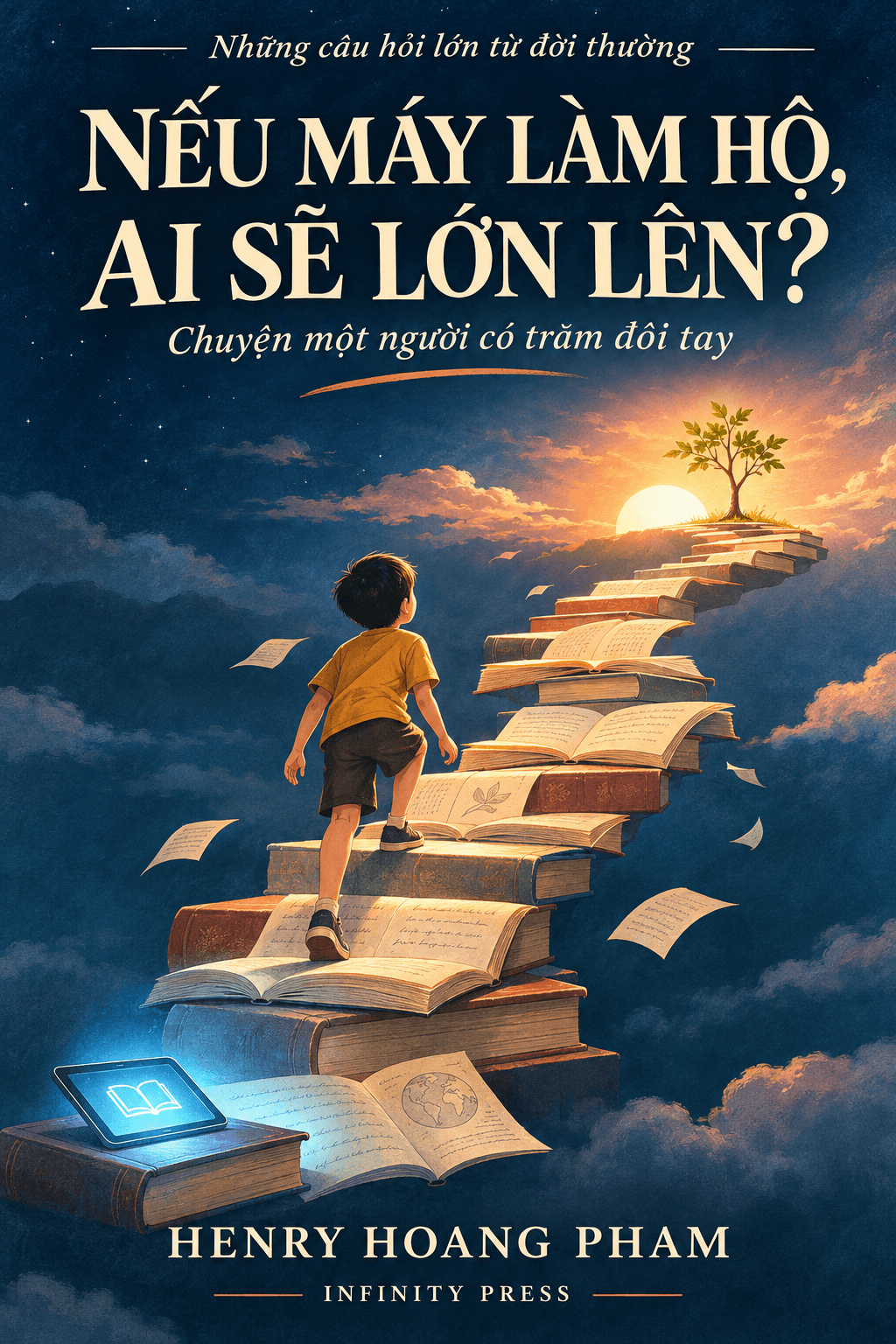
If the Machine Does It, Who Gets to Grow?
A Story About One Person with a Hundred Hands
By Henry
You will sign in with your email first.
Read online once payment is confirmed. You sign in with an email link, and bank transfers are opened after we confirm them.
Also in a bundle
- Reading, Learning, and Growing with AI
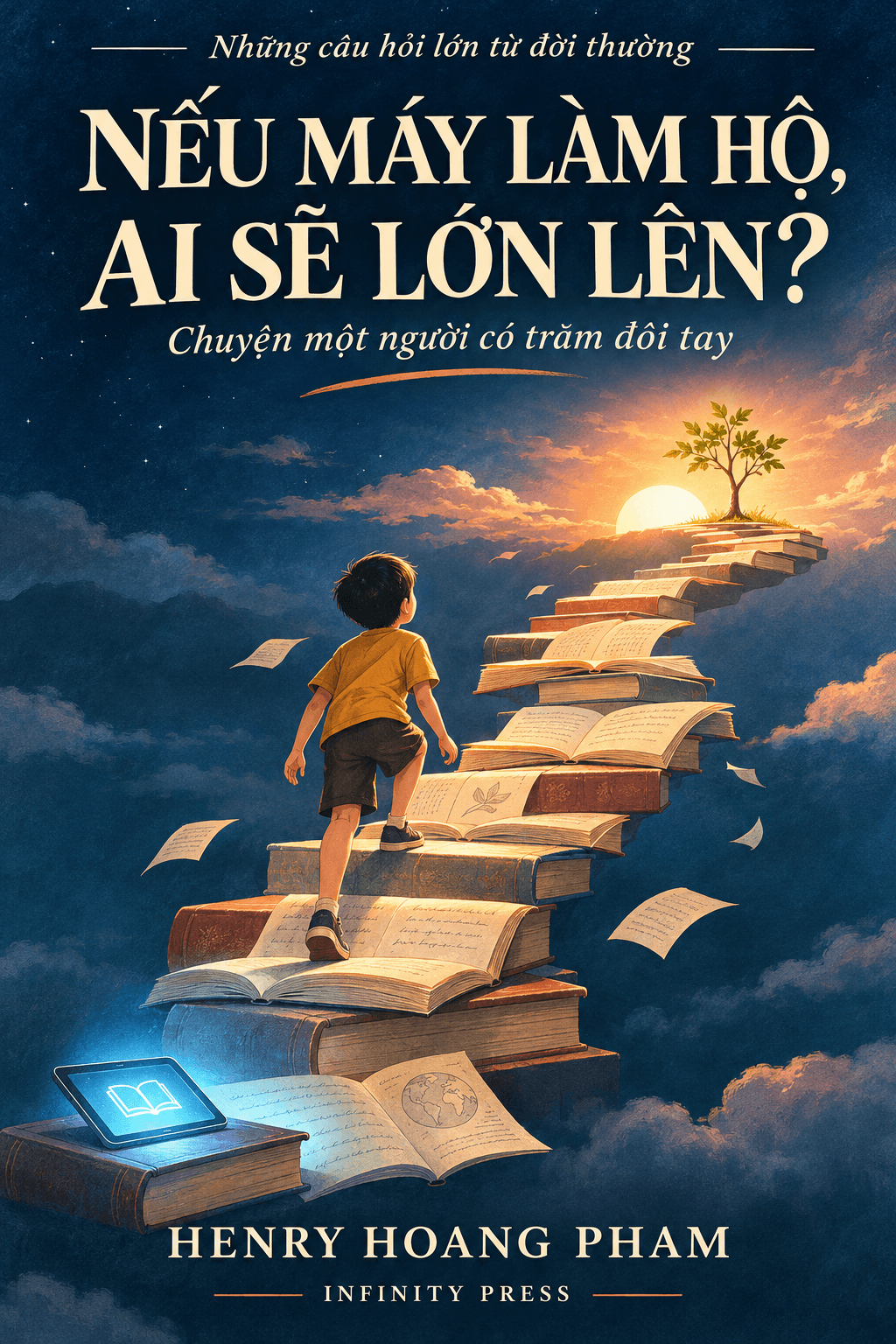
2 books
Why Read When AI Has the Answers? · If the Machine Does It, Who Gets to Grow?
₫10,000
Bình uses AI to make posters, build a website, and take cake orders for a neighborhood fair in Vietnam. Then come a cake nobody makes, homework solved without understanding, and promises nobody can keep. In twelve short chapters, Henry Hoang Pham explores AI, learning, craft, trust, and responsibility through everyday life.
If a machine can do the work for us, which parts of the work still help us grow? In a Vietnamese neighborhood, Mai, An, Bình, Lan, and Huy are preparing a book-swap and repair fair for their reading room. Bình discovers that AI can design posters, build a website, take cake orders, and send announcements in an afternoon. Soon, however, the poster advertises a cake bà Tư has never made, orders exceed what she can cook, and the website promises to repair anything for free in a single day. If the Machine Does It, Who Gets to Grow? is an original work of fiction by Henry Hoang Pham and Book 4 in Big Questions from Everyday Life. Its twelve chapters, arranged in three parts, bring questions about artificial intelligence and the future of work into familiar situations: solving homework, repairing a shelf, making a readable sign, asking permission to publish a photograph, and keeping a promise to a customer. An copies a correct answer but cannot begin when a number changes. Ông Lâm finds rotten wood the photograph did not reveal. Lan tests posters with people walking past. Huy notices the practical jobs that still need doing. Each helps Bình discover what his screen has left out. The story invites children and adults to consider what they want to learn themselves, what a machine can help with, and how they will check its work. It asks whose permission matters, who bears responsibility for a published promise, and what saved time might be for. The three parts explore how much one person can do, whether completing work means learning to do it, and what our new abilities are worth using for. An afterword and source note connect the fictional events to questions about productivity, technological limits, education, and access to AI. A thoughtful story for shared reading, classroom conversation, or reflection on everyday work with AI. Some effort remains worth choosing because doing the work changes the person doing it.
Who it is for
Children and teenagers beginning to use AI for study, writing, art, or projects. Parents looking for concrete ways to discuss learning, verification, privacy, and responsibility with their children. Teachers, librarians, and reading-group organizers seeking accessible stories for AI discussions. Creators, small-business owners, and professionals considering which tasks to delegate to machines. Readers who enjoy everyday Vietnamese fiction that leaves meaningful questions open.
Key ideas
- 01
Completion and learning are different
A correct answer does not show whether a learner can solve a changed problem.
- 02
AI can support active learning
Questions and timely hints can help a learner find the next step themselves.
- 03
Digital speed meets real capacity
An order form must account for available cakes, cooking time, and delivery limits.
- 04
Craft needs contact with reality
Images and instructions help, while a physical shelf still needs inspection and a safety check.
- 05
More options need clearer criteria
A hundred posters matter less than a sign people can actually read and use.
- 06
Breadth and depth work together
Organization, observation, and practical expertise make complementary contributions.
- 07
Permission matters before publication
A beautiful photograph still requires the agreement of the person shown.
- 08
People remain responsible for promises
AI-generated wording needs checking before it becomes a commitment to customers.
- 09
One person's work rests on many others
Online businesses depend on makers, suppliers, delivery workers, infrastructure, and trust.
- 10
Saved time leaves a choice
Free time can make room for observation, learning, rest, and being with others.
Questions and answers
What is If the Machine Does It, Who Gets to Grow? about?
A group of children and neighbors uses AI to prepare a book-swap and repair fair in Vietnam. Their successes and mistakes open questions about learning, craft, trust, and responsibility.
Is this fiction or a technical guide to AI?
It is original fiction in twelve chapters and three parts, with an afterword and source note. Ideas emerge through characters, dialogue, and practical neighborhood tasks.
Is it suitable for parents and children to read together?
Homework, cakes, repairs, photographs, and promises provide concrete starting points for a shared conversation. Readers can ask who is affected and what needs checking in each scene.
Does the book discourage using AI for learning?
It explores benefits as well as limits. When An asks for questions instead of a ready-made solution, AI helps her begin to understand the problem herself.
Why learn practical skills if AI provides instructions?
Instructions may lack crucial information about real materials or circumstances. Ông Lâm's inspection of a damaged shelf shows why experience and checks in the physical world still matter.
How does the story address privacy and AI-generated content?
Bình learns to ask bà Tư before publishing her photograph and to check promotional wording before making promises. Creating content brings responsibilities toward the people it affects.
Who wrote the book, and where does it fit in the series?
Henry Hoang Pham wrote it as Book 4 in Big Questions from Everyday Life. Its subtitle is A Story About One Person with a Hundred Hands.
Do readers need programming knowledge?
No. The story uses everyday situations to explore how people learn and make choices with AI.
Reader reviews
No reviews yet.