
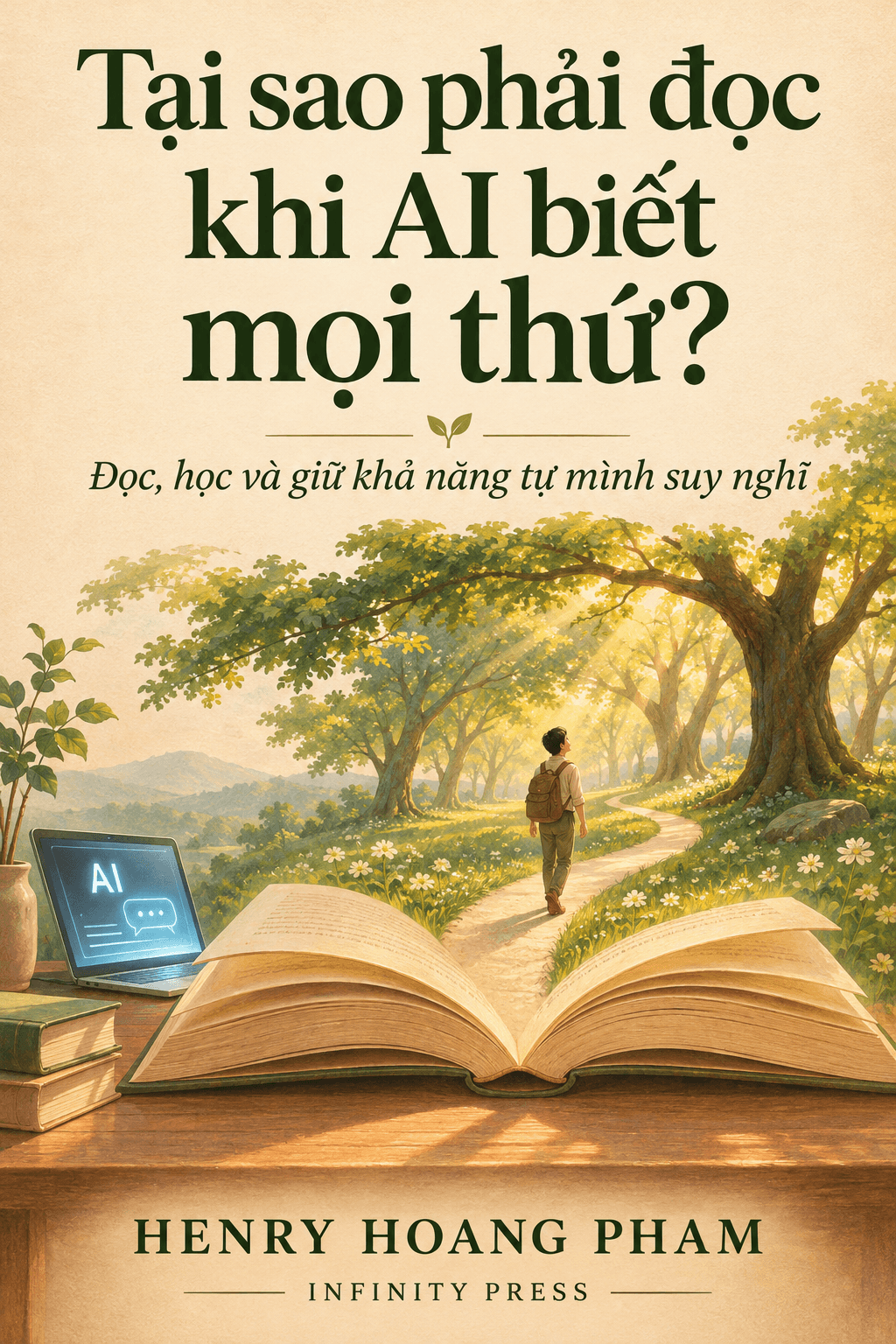
Why Read When AI Has the Answers?
Reading, Attention, and the Work of Thinking
By Henry
You will sign in with your email first.
Read online once payment is confirmed. You sign in with an email link, and bank transfers are opened after we confirm them.
Also in a bundle
- Reading, Learning, and Growing with AI
2 books
Why Read When AI Has the Answers? · If the Machine Does It, Who Gets to Grow?
₫10,000
When AI can help us find, summarize, and explain information, what still makes reading worth our time? Through twelve chapters grounded in everyday situations, Henry Hoang Pham explores attention, background knowledge, understanding, and judgment. An invitation to use AI deliberately, learn from experience, and leave room for the pleasure of reading.
An answer that arrives in seconds can solve a difficulty. It can also move us along before we notice what we really wanted to ask. Why Read When AI Has the Answers? begins with that convenience and asks which parts of reading and learning still require our own participation. The title is deliberately provocative. No AI system knows everything, and a fluent explanation can still be wrong. The book considers what a tool can actually access, what its claims rest on, and when we need to return to an original passage or real circumstances to check. Across twelve chapters, Henry Hoang Pham works through hypothetical situations close to ordinary life: weighing two job offers, navigating an unfamiliar city, interpreting an average, examining a proposal to extend a library's hours, and preparing a presentation. Each becomes an opportunity to consider evidence, assumptions, limits, and responsibility. Readers are invited to test understanding by explaining an idea themselves, changing a condition, finding a limit, and trying it in practice. Before an important question, a brief record of what has been checked, what is inferred, and what remains unknown can make a conversation with AI more useful. Learning continues when feedback changes the question or belief we began with. Reading also offers encounters that need no immediate application: a distinctive voice, a story worth staying with, or an unfamiliar subject that brings a new question into view. Time saved with AI may be used for thought, practice, conversation, rest, and the people around us. Written from the perspective of a product engineer and father of three, this book invites readers to choose when to look something up, when to read closely, and when to look again at what they believe.
Who it is for
People using AI for reading, research, or study who want to assess its answers more carefully. Students and independent learners connecting reading with explanation, practice, and feedback. Professionals and managers who need to weigh evidence and make decisions. Parents and educators considering how to nurture independent thinking as AI becomes part of everyday life. Readers who want to choose how to read while keeping room for curiosity and enjoyment.
Key ideas
- 01
Choose how to read for the task
Looking up a fact, finding a passage, and following an argument meet different needs; reading for pleasure has value too.
- 02
Know what the tool is working from
Distinguish access to a source from a plausible account of it, and check important claims against the original material.
- 03
Keep learning the fundamentals
Vocabulary, concepts, and experience help us recognize missing information and ask questions that fit the circumstances.
- 04
Put understanding to work
Explain an idea, change a condition, find its limits, and try applying it to discover what remains unclear.
- 05
Follow a way of thinking
Close reading offers time to examine how evidence supports conclusions, where assumptions enter, and how objections change a claim.
- 06
Leave room for surprise
Choose books that serve current questions while allowing unfamiliar works to raise questions we have not yet learned to ask.
- 07
Clarify an important question
Record checked observations, interpretations, and unknowns; ask AI how competing hypotheses might be distinguished.
- 08
Learn with a way back
Carry ideas through thought, rehearsal, and use, then let outcomes reshape the original question and understanding.
- 09
Decide what to do with saved time
Include the effort of verification, and make room for practice, reflection, relationships, and rest.
- 10
Let experience remain revisable
Attend to details that do not fit a familiar explanation, and match confidence to the evidence available.
Questions and answers
Does the book assume that AI knows everything?
No. The preface makes clear that the title is deliberately provocative. A system can be helpful on one task and wrong on another; important claims still need checking.
Why read a book if AI can summarize it?
A reliable introduction may be enough for an overview. Close reading can be worthwhile when you want to examine evidence, follow an argument, consider objections, or spend time with a story.
Does independent thinking require avoiding AI?
The book supports accepting help deliberately. AI can clarify, compare, and suggest objections. We still need to understand what we rely on and check results when the consequences matter.
How can I find what I do not yet understand?
Try explaining through words, a drawing, an example, or action. Change a condition and consider whether the idea still works. A single difficulty does not define your ability, but may show where further help is needed.
Do we still need to remember things when we can look them up?
Yes. Vocabulary, fundamental concepts, and task-relevant details help us recognize what to ask. Information stored externally also needs a reliable route for retrieval and verification.
Should I always write notes before asking AI?
There is no need to make this a ritual for every lookup. A pause is especially worth considering when the question could shape a judgment about another person, an important decision, or a belief that will be difficult to revise.
What approach to learning does the book suggest?
Begin with something to understand, find and choose sources, think it through, rehearse, and use it. Outcomes and feedback return to revise questions, assumptions, or methods. These activities can overlap.
Must every reading session produce a skill or a measurable result?
No. Curiosity, enjoyment of a voice, and time spent with a story have their own place. The book leaves room for reading whose value does not need an immediate practical explanation.
Ideas and articles about this book
Idea
Does knowing more mean understanding deeply?No. Information becomes understanding when we see connections, limits and what could make a conclusion wrong. Even deep understanding does not guarantee we see the present situation accurately.
Idea
Should we read less in the age of AI?Read less where lookup is enough, and more deeply where depth can build ability or change judgment. The aim is to decide what deserves attention rather than simply reduce the number of books.
Idea
Why keep reading when AI can summarize everything?AI can take us quickly to conclusions, while deep reading lets us follow how an argument is formed, tested and revised. We still read to develop judgment rather than simply obtain information.
Idea
Why observe before asking AI?Observation preserves an independent starting point, separating events from interpretations. It helps AI become a partner in examining ideas rather than framing the problem too early.
Article
From a Reading Habit to a Learning System with AIConnect observation, questions, exploration, choices, thinking, practice and reflection in a learning loop that AI can support.
Article
When Knowledge Becomes Abundant, What Remains Scarce?AI makes information easier to access, while attention, experience, judgment, courage and purpose still require more than additional information.
Reader reviews
No reviews yet.